
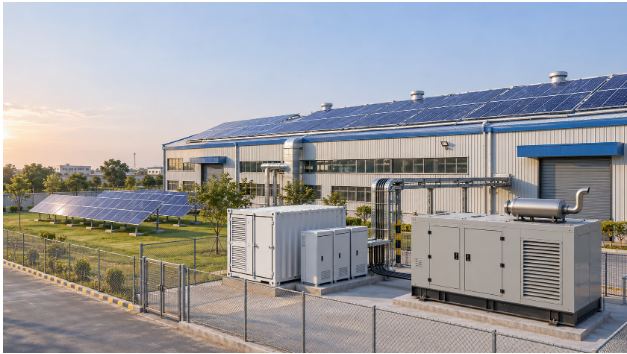
A diesel generator keeps a business operating when the grid fails. The expense continues for every hour the engine runs, even when the building needs far less power than the generator can supply.
For a factory, warehouse or commercial building, reducing this expense starts with two separate targets: burning fewer litres of diesel and running the engine for fewer hours.
A solar hybrid system can help achieve both. However, adding panels alone does not guarantee that the generator will switch off. The result depends on the load, available sunlight, battery capacity and the equipment controlling the power supply.
How a Solar Hybrid System Works
A solar hybrid installation combines solar panels with another power source, such as a diesel generator or the utility grid. It may also include battery storage.
During daylight, solar supplies part of the building’s electricity demand. The generator or grid covers any shortfall. Where batteries are installed, surplus electricity can be stored for later use.
There are two common arrangements:
| Operating feature | Solar and diesel without batteries | Solar, batteries and diesel |
|---|---|---|
| Daytime supply | Solar shares the load with the generator | Solar supplies the load and can charge batteries |
| Generator operation during an outage | Usually remains running to support the local electrical supply | Can stop when the inverter and batteries can support the load |
| Power after sunset | Supplied by the generator | Supplied by batteries within their limits, then the generator |
| Main design concern | Generator loading and changing solar output | Battery power, stored energy and generator start settings |
One detail deserves attention before any installation: ordinary solar connected to the grid generally shuts down during a power cut. Supplying a building through an outage requires equipment configured for backup operation and isolation from the utility network. Existing rooftop panels do not automatically provide this capability. Source: U.S. Department of Energy
Why Lower Fuel Consumption Does Not Always Mean Fewer Run Hours
Suppose a business needs 100 kW during a daytime outage. If solar supplies 40 kW, the generator supplies the remaining demand, allowing for system losses and operating limits.
The generator’s electrical output falls, and its fuel consumption can fall too. But if it must remain running to maintain the local supply, the hour meter keeps advancing.
Fuel use also does not fall in exact proportion to electrical output. An engine still consumes fuel to keep running. Replacing half its electrical output with solar should not be treated as a guaranteed 50% reduction in diesel consumption.
To cut engine hours, the system needs a way to supply the required power while the generator is off. In a solar and battery installation, a suitable battery inverter can establish the voltage and frequency that the local network needs. The generator can then stop while available solar and battery output cover demand. Manufacturer documentation describes this type of operation using battery inverters with grid forming capability. Source: SMA Solar
That distinction should appear clearly in every proposal: how many litres will be avoided, and how many operating hours will be removed?
Protect the Generator From Prolonged Light Loading
Solar can introduce a problem if a large generator is left supplying only a small remaining load.
Caterpillar warns that extended operation below 30% of rated output can cause wet stacking and deposit buildup in diesel generator sets. The appropriate operating limits depend on the engine, its rating and manufacturer guidance. A percentage taken from a general article should never replace the instructions for the installed machine. Source: Caterpillar
For example, a generator rated at 200 kW would be operating at 20% load if it supplied only 40 kW.
A suitable controller may limit solar output, arrange battery charging or change which generators are running. SMA’s controller documentation specifically describes reducing solar output to maintain minimum generator loading and managing the risk of reverse power flowing into a generator. Source: SMA Fuel Save Controller technical documentation
More panels are useful only when their output can be used within the system’s operating limits.
Practical Steps to Reduce Diesel Use and Engine Hours
1. Establish the Current Fuel and Load Baseline
Record generator operating hours, fuel consumption and electricity supplied over a representative period. Include busy days, quiet days and different production shifts.
Fuel purchases alone are a weak baseline because deliveries may change the amount stored in the tank. Use measured consumption with stock reconciliation where possible.
Track:
- Generator start and stop times.
- Electricity supplied in kWh.
- Average and peak demand in kW.
- Diesel consumed in litres.
- The timing and duration of grid outages.
These records help distinguish a generator that runs heavily loaded for a few hours from one that spends most of its day supplying a light load.
2. Match Solar Output to the Hours Diesel Is Being Used
A business with substantial daytime generator use has an opportunity to replace some of that generation directly with solar.
The assessment should compare expected solar output with the load at the same time of day. Monthly electricity totals cannot show whether generation and demand actually overlap.
A warehouse using most of its electricity after sunset needs a different design from a factory operating mainly during daylight.
When reviewing commercial and industrial solar installations, ask for the expected solar energy used on site, the energy restricted by controls and the diesel generation displaced.
3. Size Batteries for Both Power and Duration
Battery capacity must answer two questions: how much equipment can it supply at once, and for how long?
For illustration, a steady 40 kW load requires 80 kWh of delivered electricity to operate for two hours. The battery’s nameplate capacity would need to account for conversion losses, the permitted discharge range and the required reserve.
The inverter must also support the load’s power demand. Starting motors, pumps or compressors can require substantially more power than their normal running demand. NREL’s microgrid design guidance identifies motor starting currents, reserve capacity and load characteristics as factors in equipment sizing. Source: NREL, Microgrids for Energy Resilience
A battery energy storage system should therefore be selected around the equipment it must support and the intended period without generator operation.
4. Specify Exactly When the Generator Starts and Stops
The operating sequence determines whether the proposed equipment delivers useful savings.
Ask the designer to explain what happens when clouds reduce solar output, a large motor starts, the battery reaches its reserve level or the utility supply returns.
The settings should allow enough battery reserve for the generator to start and accept load. They should also avoid frequent starts and stops, while respecting generator loading limits.
The proposed sequence needs to be checked against the actual electrical installation and demonstrated during commissioning.
5. Move Suitable Work Into Daylight Hours
Where production permits, schedule flexible tasks when solar output is available.
Examples might include water pumping, selected batch processes or charging electric handling equipment. Using solar directly for these tasks can reduce the amount of energy that needs to pass through batteries.
Base scheduling changes on production needs and measured demand. Moving several large loads to noon at once may create a new peak that the system must cover.
6. Keep Maintenance and Performance Records
Reduced operating hours can change when service intervals based on engine hours are reached. Calendar requirements still apply.
Continue the manufacturer’s maintenance schedule and record fuel use, generator hours, solar production and battery performance after installation. Compare periods with similar production and outage conditions.
A lower fuel bill during a quiet month does not, by itself, prove that the hybrid system is performing as expected.
An Illustrative Monthly Fuel Savings Calculation
Consider a business operating for 26 days each month.
The figures below are assumptions for explaining the calculation. They are not a site forecast, a current diesel price or a promised saving.
| Measure | Diesel only | Solar hybrid with battery storage |
|---|---|---|
| Generator operation per day | 8 hours | 4 hours |
| Average fuel use while running | 20 litres per hour | 16 litres per hour |
| Operating days per month | 26 | 26 |
| Monthly generator hours | 208 | 104 |
| Monthly diesel consumption | 4,160 litres | 1,664 litres |
| Assumed diesel price | PKR 300 per litre | PKR 300 per litre |
| Monthly fuel expense | PKR 1,248,000 | PKR 499,200 |
In this example:
- Diesel saved: 2,496 litres per month.
- Fuel expense avoided: PKR 748,800 per month.
- Generator hours avoided: 104 hours per month.
Fuel consumption falls by 60%, while engine hours fall by 50%. The percentages differ because the assumed hourly fuel consumption also changes.
For a real project, the proposed running hours must come from a simulation of solar output, demand and battery operation. Fuel rates should come from measured performance or the generator manufacturer’s consumption data at the relevant loads.
The calculation does not establish the required solar capacity, battery size or project payback.
Compare the Full Cost of Each Option
Fuel savings are only one part of the decision.
Include solar equipment, batteries, controls, switchgear, installation and commissioning in the initial cost. Then account for maintenance, battery losses, expected replacements and financing over the intended operating life.
Any expected reduction in generator servicing should be supported by the maintenance schedule. Some costs depend on running hours; others remain payable with time.
Also separate electricity bill savings from diesel savings. A unit of solar electricity used to replace generator output cannot simultaneously be counted as replacing purchased grid electricity.
Compare the options over the same period and under the same production and outage assumptions.
When Keeping Diesel as the Main Backup Still Makes Sense
A generator used for only a few hours each year may offer limited fuel savings to recover the cost of a substantial battery installation.
Sites with high overnight demand also need careful assessment. Storage must be large enough to cover the intended operating period, and the generator may still be needed through extended outages or poor solar conditions.
For these businesses, retaining diesel backup can remain practical. Solar may still reduce daytime electricity purchases, with battery storage considered separately against the hours of backup it can economically provide.
Assess the Generator, Solar and Storage Together
A useful proposal should show the current fuel baseline, expected diesel consumption after installation, remaining generator hours and the assumptions behind each figure.
It should also explain how essential equipment will stay supplied when sunlight changes or the generator stops.
Orient Energy Systems provides diesel generation, solar, storage and microgrid control systems. Reviewing these together allows the proposed operating sequence to be assessed alongside the equipment. Source: Orient Energy Systems
Start with the site’s load and outage records. They provide the basis for deciding which generator hours can be avoided and what equipment is needed to avoid them.