
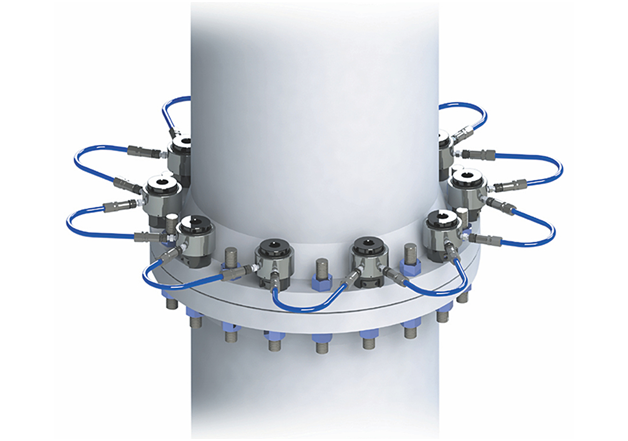
Walk around any big site in India, like a refinery, a steel plant or a wind farm, and you’ll find thousands of bolts holding things together. Some are small enough to tighten by hand. Many are not. A large flange or a tower bolt can need more force than any person can apply with a spanner, and it has to be the right force, not just “very tight”.
That’s why most maintenance teams now use a bolt tightening machine for heavy and critical joints. It tightens each bolt to a set torque, so the joint is neither loose nor overloaded. And it saves the crew a lot of tiring work.
Bolt Tightening Machines Come in a Few Power Types
Most of these machines are torque wrenches of some kind. They differ mainly in how they’re powered.
Hydraulic
Hydraulic wrenches are used for the biggest bolts, such as pipeline flanges, turbine casings and heavy machinery. A separate pump supplies the pressure. Square drive models take normal sockets, while low clearance models slip onto the nut where there isn’t much room.
Electric and Battery
Electric wrenches plug into a power point and are quick to set up. Some models can save each tightening reading, which helps when a client asks for a record of the work. Battery models do the same job without a cable, so they’re handy on towers, tall structures or anywhere far from a socket.
Pneumatic
Air-powered torque wrenches run off the site’s compressed air line. They turn smoothly through a gearbox, without the hammering of an impact wrench, so they’re quieter and more accurate.
What to Check Before Buying a Nut Bolt Tightening Machine
Before you pick a nut bolt tightening machine, think about the job it’ll mostly do, not just the biggest one. A few questions help:
- What’s the highest torque you’ll need, and the most common?
- How much space is there around the nut?
- Is power, air or neither easily available on site?
- Do you need a record of each bolt for quality checks?
- Will the machine be carried up ladders or towers?
Honestly, a lot of teams buy the most powerful model and then find it’s too heavy for everyday jobs. A smaller machine that covers most of your bolts is often the better buy, with a bigger one hired or kept for the odd large job.
Calibration matters too. A machine that’s out of calibration will tighten every bolt wrongly, so get it checked as often as the maker recommends.
Conclusion
A bolt tightening machine brings the right torque to heavy bolts and saves a lot of time and effort. Choose a nut bolt tightening machine that matches your torque range, working space and power supply on site.
POWERMASTER, founded in 1971, makes hydraulic, electric, battery and pneumatic torque wrenches. Its hydraulic wrenches are calibrated to ±3% repeatability.