

A novelist I know has spent fifteen years building an audience the way most literary fiction writers do: one book at a time, one review at a time, a newsletter that goes out when she has something to say and is opened by the people who care enough about her work to have signed up for it. She’s not famous. She has a dedicated readership of several thousand people who’ve read everything she’s published and will read everything she publishes next. In publishing terms, that’s genuinely valuable — a guaranteed floor for any new book, a word-of-mouth network, and the kind of sustained reader relationship that’s increasingly rare.
What she doesn’t have is a way to deepen those relationships between books. Her readers exist in her newsletter list and in her memory of the people who’ve emailed her over the years. Between a book’s launch period and the next one — a gap that’s often two or three years — the connection is largely dormant. She’d like to change that, but the tools she has available — social media platforms that have changed their algorithms in ways that have reduced organic reach, a newsletter that feels one-directional no matter how much she responds to replies — don’t quite do what she’s imagining.
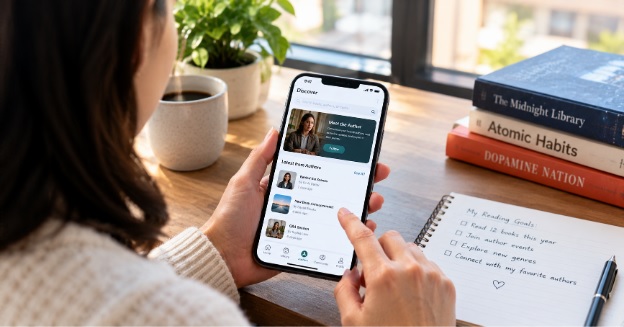
What she’s imagining is closer to what a well-built reader engagement app could provide. Something that lives on the phones of the people who care about her work and creates touchpoints between books that maintain and deepen the relationship rather than letting it go quiet until the next launch cycle. A Mobile App Development company in Austin building for this market would understand that the author-reader relationship is one of the more underserved connection problems in the creative economy — valuable, deeply human, and currently addressed by tools that were built for different purposes and serve this one imperfectly.
Why the Existing Tools Fall Short
The tools authors currently use to connect with readers — social media platforms, email newsletters, author websites, and the fragmented ecosystem of reading apps that don’t connect to author platforms — were each built for something adjacent to author-reader connection rather than for it specifically.
Social media was built for broad network broadcasting. It works for building initial awareness and for viral moments of attention. It’s poorly suited for maintaining deep connection with a dedicated readership, partly because the algorithm that determines who sees what is optimized for engagement metrics that don’t favor the kind of thoughtful, slower-burning content that literary authors and their readers tend to prefer, and partly because the audience that a novelist has built over years shares the platform with every other account those readers follow, competing for attention that a dedicated reader application would have access to without competing for.
Email newsletters have become the closest thing to a reliable owned channel for authors, and for good reasons — the list belongs to the author, the message reaches the reader’s inbox without algorithm mediation, and the format allows for longer, more considered content than social media accommodates well. The limitation is directional: newsletters are fundamentally broadcast tools, and the reader who receives one is a recipient rather than a participant. The author who sends a monthly newsletter to three thousand readers is communicating to them, not with them, and the relationship that emerges is appreciation rather than connection.
Author websites, reading tracker apps like Goodreads, and bookstore platforms each capture part of the relationship ecosystem — the author’s output, the reader’s tracking and reviewing activity, the commercial transaction — without integrating them into a coherent experience of the ongoing author-reader relationship. A reader who has followed an author’s work for years has touchpoints scattered across multiple platforms that the author doesn’t own and that don’t know about each other.
What a Reader-Focused Author App Could Actually Do
The gap between what authors want from reader connection and what existing tools provide is specific enough that it’s worth describing what a purpose-built app would actually contain — because “author app” has a history of meaning a promotional website dressed up as an application rather than a genuine engagement tool.
Reading companion content is the starting point. An author who can provide supplementary material — behind-the-scenes notes on a novel’s research, deleted scenes, alternate character perspectives, reading guides for book clubs — through an app that readers access while or after reading the book creates a dimension of reader engagement that the book itself can only gesture toward. This kind of supplementary content has always existed in some form — the interview, the author’s note, the acknowledgments — but it’s been distributed in ways that require the reader to seek it out and that don’t connect to the reading experience at the moment it’s most relevant.
A reader who finishes a chapter in which a historical event is central and can immediately access the author’s research notes on that event, or who encounters a character whose backstory only partly makes it onto the page and can access the fuller version through an app, is having a reading experience that deepens the book rather than supplementing it. This isn’t about providing more content for its own sake. It’s about being present in the reading experience in a way that correspondence and newsletters and social media can’t replicate because they exist outside the reading rather than alongside it.
Community creation is the second dimension. The readers who most value an author’s work often have no way to find each other. They exist as individual members of a newsletter list who don’t know the others are there. The author-specific community — readers who share a specific taste formed by the same body of work, who have references and aesthetic sensibilities in common without having met — is a community that would have real value to its members if they could connect, and that provides authors with a feedback environment richer than what email open rates and Amazon reviews offer.
Building this community requires more than a comment section. It requires community architecture that creates the conditions for genuine conversation — discussion prompts tied to specific works, reading groups that can coordinate and schedule through the app, community features that allow readers to share their own responses to specific passages or characters in ways that become part of the shared experience of the work rather than just individual reactions to it.
Author-to-Reader Communication That Feels Like Communication
The directional problem with newsletters — broadcast rather than dialogue — can be partially addressed through app features that create genuine feedback loops between authors and their readers.
Early draft access for dedicated readers, delivered through an app with a structured feedback mechanism, transforms the traditional reader-to-author relationship. Instead of receiving a finished work and sending a review, readers can participate in a work’s development — responding to early chapters, identifying where their attention holds and where it wanders, asking questions that the author can use to identify what the work needs to make explicit versus what it successfully implies. This is a form of connection that the most valued reader relationships have historically involved informally — the friend who reads drafts, the trusted beta reader — made accessible at a larger scale through technology that structures and mediates the feedback relationship.
Q&A sessions conducted through an app — where readers submit questions over time that the author addresses in recorded audio or video that all readers access — create a sense of ongoing dialogue that the asynchronous, scheduled nature of social media live events doesn’t quite produce. The reader who has a question while reading a book and can submit it through the app, then receives an answer from the author three weeks later that others can also see and respond to, is in a different relationship with the author than one who poses questions in a comment thread under a social post that may or may not get a response.
The Business Model That Supports Sustainable Author Platforms
Author apps face a business model challenge that’s worth naming directly: the existing systems for author income — advances, royalties, speaking fees — don’t naturally connect to reader engagement infrastructure investment, and the per-reader economics of writing make it difficult to justify significant technology investment unless the platform creates revenue that the existing model doesn’t.
Several approaches to this have emerged that align reader value and author sustainability. Premium reader clubs delivered through an app — where a monthly subscription provides access to supplementary content, community features, early draft access, and occasional direct interaction with the author — create a recurring revenue stream from the most engaged segment of an author’s readership. The readers most likely to subscribe to this tier are the ones who would drive word-of-mouth recommendation regardless, which means monetizing engagement with the readers most likely to sustain it doesn’t come at the cost of the organic promotion that makes that engagement valuable in the first place.
Among the top mobile app ideas for creative industries that have genuine commercial traction, author-specific reader communities rank among the less-explored but most promising. The Patreon model demonstrated the willingness of dedicated fans to pay for direct creator access; the reading-specific version of that model hasn’t been built with the depth of features that reading as an experience warrants.
Backlist discovery through an app is another dimension with both reader value and business implication. An author with ten novels faces the challenge that readers who discover them through the most recent often don’t find their way back to the earlier work without a deliberate effort. An app that curates reading order recommendations, provides entry points into the backlist for different reader preferences, and tracks which books a reader has read creates a discovery mechanism that supports backlist sales in ways that no current platform does specifically.
The Community of Practice Dimension
Authors connecting with readers through mobile apps isn’t only about the individual author-to-individual-reader relationship. It’s also about what becomes possible when readers with shared taste can find each other and organize around that shared taste in ways that benefit the broader literary culture rather than just the individual commercial relationship.
The book club has existed for a century as an institution for readers to gather around shared reading. The technology for creating and coordinating book clubs has been terrible in every version anyone has tried to build — separate coordination tools, goodreads groups that never quite organized into actual meetings, Facebook groups that got lost in the noise of the platform they lived on. An author app that provided genuine book club infrastructure — coordinated reading schedules, discussion guides written by the author specifically for club use, direct author participation in club discussions at intervals, and connection between clubs reading the same work — would create something genuinely new in the reading experience rather than an incremental improvement on existing tools.
The Austin literary scene that a locally-based mobile development team would understand provides a specific context for why community features matter — Austin has a significant literary culture supported by institutions like the Texas Book Festival, BookPeople, and a community of writers and readers who have historically organized in physical space. The app that extends that community into mobile for readers who are geographically spread but share the same literary tastes is solving a real coordination problem that exists in every city with a literary community and that no current tool addresses specifically.
What the Novelist Is Still Imagining
She hasn’t built her app yet. The development cost and the uncertainty about whether her readership would adopt it have kept the idea at the imagining stage, which is where most good ideas about author-reader connection seem to live.
What she’s imagining is specific enough to suggest what the market needs: a space that belongs to her and her readers rather than to a platform company whose interests are adjacent to but not aligned with the relationship she’s trying to build. A place where the people who’ve read everything she’s written can find each other without her having to manage a community that takes more time than she has. A way to be present in the reading experience rather than only around it, before it, and after it.
The technology for this exists. The business model for it is emerging in adjacent creative industries. The author who builds it well — who treats their readership as a community worth investing in rather than an audience to be periodically marketed to — will have built something that makes both their work and their readers’ experience of it richer.
That seems worth imagining, and eventually worth building.